I, of course, refer to the chessboard version of Wellington’s victory, the Grand Match between Howard Staunton and Pierre Charles Fournier de St Amant, at Paris in 1843.
Staunton’s contemporaries had no doubt that this victory conferred the title of World Chess Champion on the English warrior of the mind. Before transatlantic steam travel became the norm, domination of Europe was synonymous with global hegemony.
Thus, Elijah Williams, President of the Bristol Chess Club, hailed Staunton as “The Champion of Chess” at a dinner held in his honour early in 1844. The following year, at the 1845 dinner of the Yorkshire Chess Association, a speaker explained that: “Chess was practised in England in earlier days, but the sceptre has always been wielded by a foreigner; now, however, we have the satisfaction of knowing that the Chess Champion is an Englishman.”
Indeed, Staunton’s win in the Paris match was not just the forerunner of modern world championships to come, but the English triumph was registered against the heir of those sublime champions, Philidor and Labourdonnais. Saint Amant was, therefore, surrounded by that special aura which attached itself to the leading representative of the greatest chess-playing nation on earth.
In November 1843, Staunton, with Capt. Wilson and Mr Worrall, as his seconds, arrived in Paris for the match against his formidable French adversary. On the 14th of that month, the match began, with St Amant the clear favourite.
The stakes were £100 a side (in total the equivalent of £30,000 in today’s debased coinage), and four games were to be played each week. The winner of the first eleven (draws not counting) would be declared the victor ludorum.
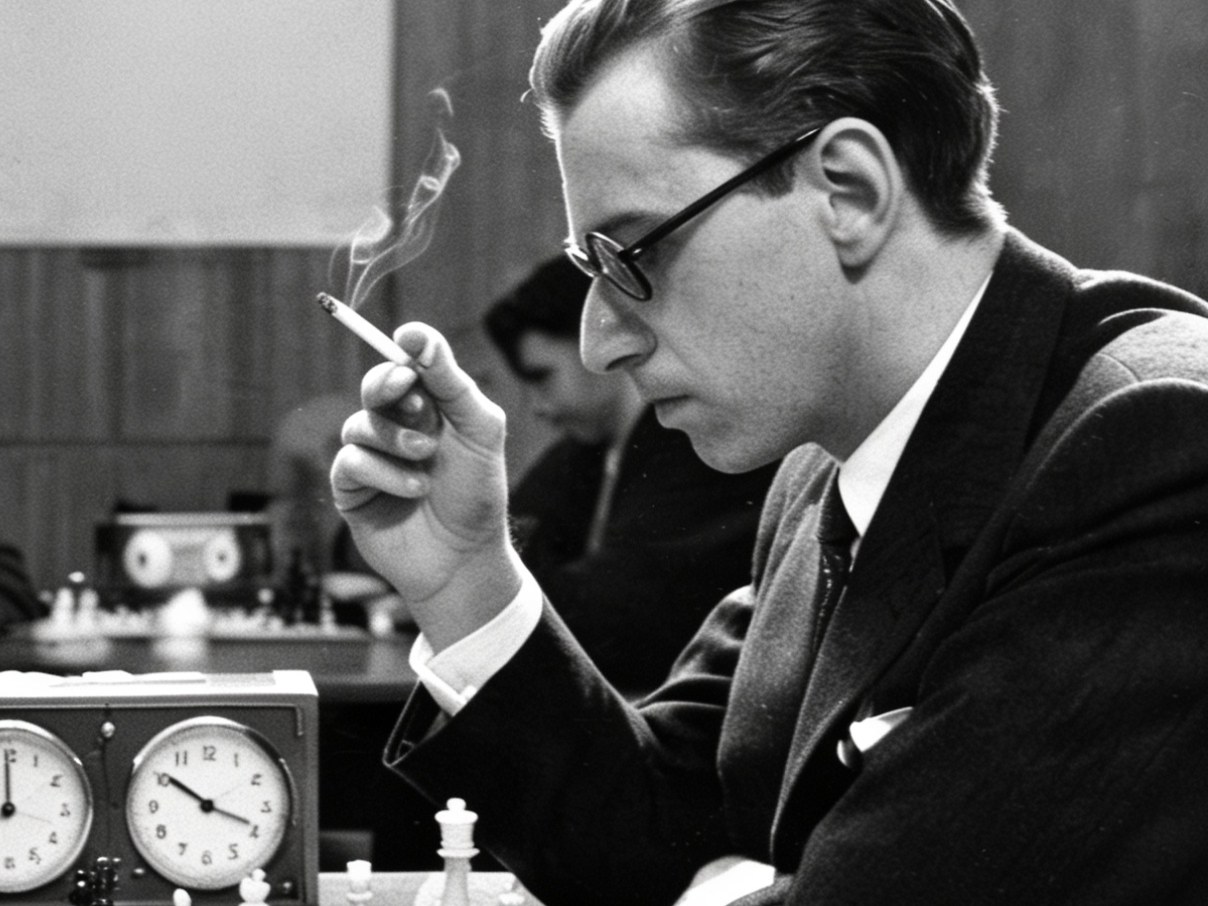
There was, as is also now the case, no provision for adjournments, each game being played right through without a break. There were as yet no chess clocks or time controls. Unlike today, however, the spectators were allowed to crowd the players as closely as in any chess café.
The progress of the match revealed both the strength and weakness of Staunton as a chess player. He staggered the chess world by conceding only one draw in the first eight games, and the excitement which prevailed equalled anything which arose during the 1972 Fischer-Spassky match. “In the chess clubs of the country,” wrote one fan, “the greatest excitement prevailed, and the games, as and when received, were played over and over.” All around the country, there were converts to the game of chess, demanding particulars of the games of the “Grand Match”.
The press suddenly found that chess was news.
In the 9th game, Staunton blundered in a won position, and of the next three, he won two and only lost the other by going wrong again after recovering to a won position from an inferior opening. But for his two errors, he might, after twelve games, have scored 11-0 with one draw, but as it was, he stood 9-2 with the one game drawn. It was Staunton’s intermittent lack of accuracy that was beyond the comprehension of so phenomenally accurate a player as Paul Morphy — though the American was only a child of six at the time.
At this point in the match, Saint-Amant staged a remarkable recovery. At the start of the 19th game, Howard Staunton and Pierre Charles Fourni when the score stood at 10-4, with four draws, in favour of Staunton, “such was the anxiety of the public to witness the skill of Mr. Staunton and the heroic resistance of Saint-Amant, that both parties suffered terribly from the heat, and gendarmes had to be posted at the club doors to refuse further admittance.”
Staunton had been further upset that Captain Wilson had not been able to stay with him during the last few games. But after losing the 20th game, “the worst played partie of the match”, he pulled himself together for a final effort in the 21st. Only 29 moves were completed in the first eight hours, and for the first time, the no-adjournment rule was waived, the players being allowed an hour’s rest. They resumed and reached the 54th move some time after midnight, so once more it was decided that an adjournment, this time till the following morning, should be allowed. Finally, on 20th December, after 14 hours of play, the game and the match went to Staunton by 11-6 with 4 draws. British chess stood at its highest level.
More than that, Staunton’s victory made London, instead of Paris, the Mecca of international chess masters. Horwitz took up permanent residence in 1845. Harrwitz, after a visit in 1846, lived in England from 1849 to 1856. And later came Löwenthal and others, including the great Wilhelm Steinitz. Even home players were attracted to London. Elijah Williams left Bristol and moved to the capital, to the great benefit of his play.
The debt owed to Staunton by English chess was incalculable.
A rematch was planned, but it never took place, not least because the tide of history had swept Staunton and London to the fore. The time had come for the foreign matadors of the mind to visit Staunton in London if they wanted to cross mental swords with him. Thus, three years after his Parisian perihelion, Staunton crushed the European masters Horwitz and Harrwitz by the respective scores of 15.5 to 8.5 and 12.5 to 9.5. It could rightly be said, as the conspirators remarked of Julius Caesar in Shakespeare’s eponymous play: Why man, he doth bestride the narrow world like a Colossus!