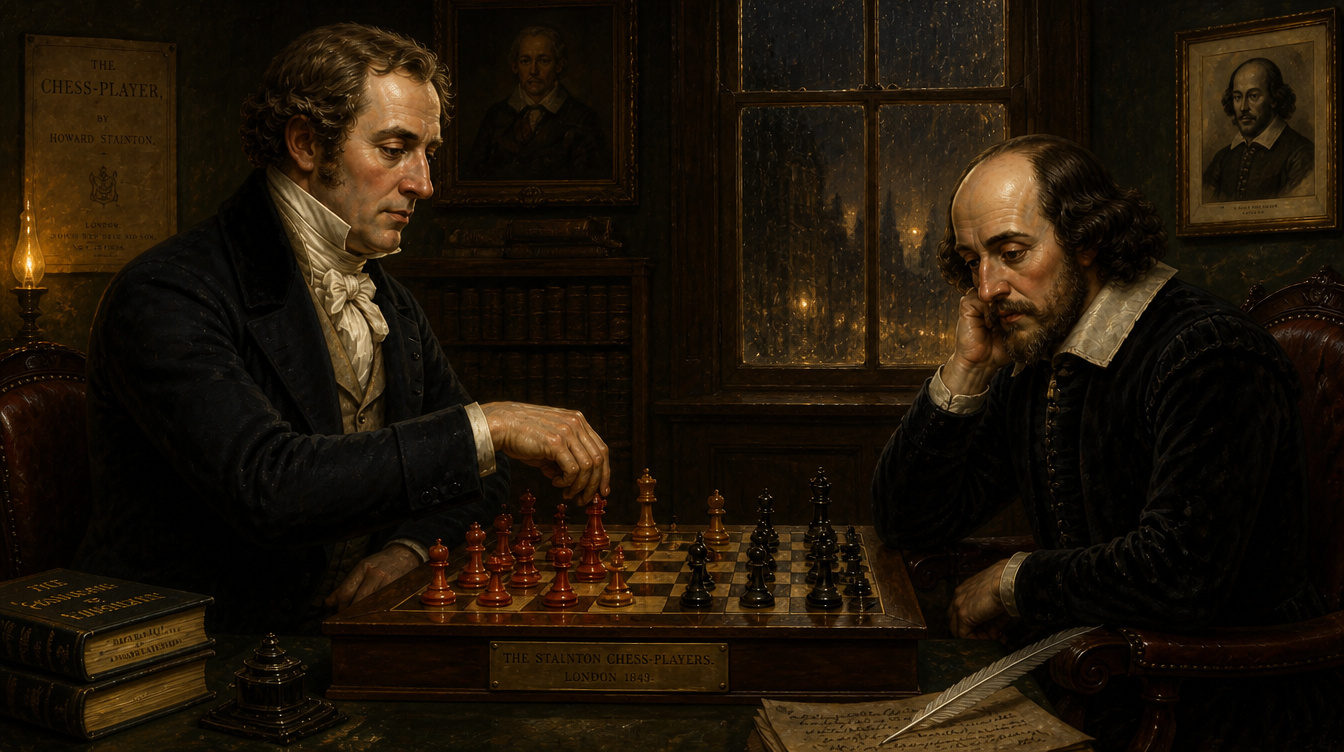
Howard Staunton loved Shakespeare. In later life, he edited a version of Shakespeare’s complete works. It is even arguable that, in his youth, Staunton was a Shakespearean actor, actually appearing with the celebrated Edmund Kean (1787-1833).
The timeline certainly fits.
Sadly…It seems that there is a modern fashion for omitting the best lines from stage presentations of the great English classics. Thus, my favourite line from Shakespeare’s contemporary, Christopher Marlowe — “Egregious viceroys of these Eastern parts” — which ringingly opens his Tamburlaine the Great, Part Two, is now standardly excised from theatrical productions. When the line is retained, it is reduced to the anodyne “most noble viceroys”, which does not even have the same meaning. A similar case can be seen in those lines spoken by Hamlet in Act Five, which to me seem to encapsulate the entire meaning of Shakespeare’s play:
Imperious Caesar, dead and turned to clay,
Might stop a hole to keep the wind away.
Oh, that that earth which kept the world in awe
Should patch a wall t’expel the winters flaw!
It is many years since I have attended a performance of Hamlet which included those, to my mind crucial, lines.
Words are like shapeshifters from mythology or science fiction.
Dalek, the mortal foe of Dr Who, comes from the Russian adjective dalek, meaning faraway, foreign or, indeed, alien. The word “Tulip” originally meant a hat, but was misconstrued by a Dutch trader in Istanbul to signify a flower. All Russian railway stations are called Vauxhall, since Czar Nicholas II, on a state visit, happened to ask what the British railway system was called, while his train was passing through Vauxhall. “Algebra” and “gibberish” share the same linguistic root. The Welsh word for a pharmacy, “Ferfylla”, is derived from “Ferylt”, the Welsh interpretation of the name of the Latin poet Virgil, whose Messianic Eclogue, curiously imitating a prophetic passage from the Biblical Book of Isaiah, earned him a reputation as a vatic visionary, magician or alchemist.
Caesar himself lent his name to the names of rulers such as Kaiser and Czar. Even Queen Victoria, Empress of India, was known there as “Kaisar I Hind”, or “Caesar of India”, while the mythological national hero of Tibet, Joru Gesar, is clearly based on Julius Caesar.
So where does the word chess come from?
Chess is an hierarchical game, redolent of courts and rulers.
Dictionaries do not give clear origins, simply similar words e.g. from mediaeval French. What has to be borne in mind is that Julius Caesar is simply the English rendition of the Roman Dictator’s name. In Italian it is Giulio Cesare (pronounced Chessare), with the C pronounced as “Ch”. So: does the word chess, the game of Kings and Emperors, such as Alexius Comnenus of Byzantium, Czar Peter the Great and Napoleon Bonaparte, actually owe its derivation to Julius Caesar? Or, to quote Hamlet: t’were it to consider, too curiously, to consider so?