At the height of the excitement generated by the so-called Da Vinci Code, The Times sent me an intriguingly futuristic chess diagram and invited me to decipher it. At first glance it recalled the surrealist chess designs of Max Ernst from 1944, yet its true provenance proved far more remarkable. It originated in one of the earliest masterpieces of chess literature, a work long believed lost for almost five centuries before its dramatic reappearance.
I explained in The Times that the rediscovery of this manuscript represented far more than an antiquarian curiosity. There was a persuasive suggestion that the chess diagrams had not merely been inspired by Leonardo da Vinci but actually designed and drawn by him and, most tantalisingly of all, that he may even have composed the positions themselves.
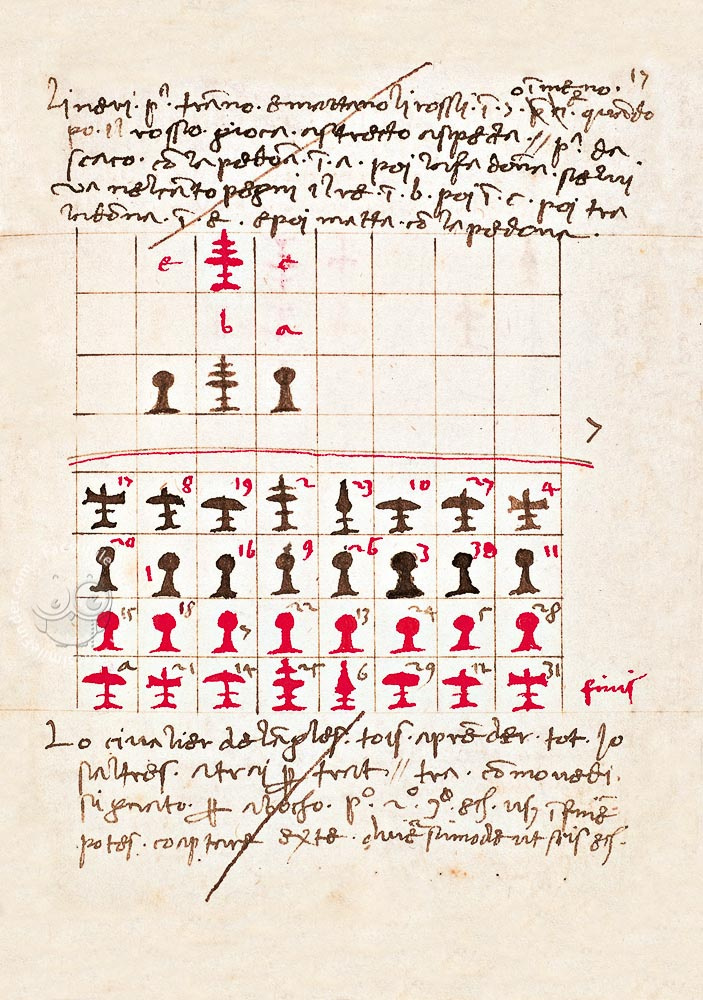 The volume in question, De ludo schacorum (On the Game of Chess), was written by the Renaissance mathematician Luca Pacioli, whose career spanned the latter half of the fifteenth century and the opening decades of the sixteenth. Around 1475, the revolutionary "new chess" transformed the game by vastly increasing the powers of several pieces. Pacioli's long-lost treatise was believed to contain instructional positions illustrating both the medieval form of chess and the modern version, known as a la rabiosa — "with the furious queen" — in recognition of the dramatically enhanced strength of that piece. It is, of course, this form of chess that survives today.
The puzzles illustrating the new game were thought to demonstrate the practical implications of the enhanced queen, bishop and pawn. Yet the manuscript itself had disappeared, prompting some historians to question whether it had ever existed. Then came an extraordinary development. The book emerged from the 22,000-volume library of Count Guglielmo Coronini, whereupon facsimile editions were prepared, revealing elegant red-and-black diagrams of striking originality.
At the time, The Guardian published what was then the only readily accessible puzzle from the manuscript, accompanied by commentary from its chess correspondent, who candidly admitted that he "did not have the foggiest idea" what the position represented or whether it belonged to the old or the new game. His perplexity was entirely understandable. The diagram gave no indication of whose move it was, failed to identify the pieces with certainty and omitted any statement of the objective, such as "White to play and mate in two". It was a thoroughly Da Vincian enigma, overshadowed by the obvious central question: did Leonardo merely design the pieces, or did he also create the puzzle itself?
Having examined the position in considerably greater depth, I established that it unquestionably belonged to the rabiosa version of chess, the game we still play today. More importantly, I discovered that the position concealed an extraordinarily intricate forced checkmate.
That finding struck me as astonishing. The new rules had been in existence for only a handful of years when Pacioli's manuscript was compiled.
Whoever composed the position possessed an exceptional understanding of the transformed game and demonstrated creative powers of a very high order.
Its instructional value is equally impressive. The solution brilliantly exhibits the expanded scope of the queen and bishop while illustrating the formidable possibilities of pawn promotion. Under normal circumstances promotion to a queen decides the struggle. Yet in this extraordinary composition the losing side succeeds in promoting with check, only to be defeated regardless.
What, then, of Leonardo da Vinci's alleged involvement, as proposed by the manuscript's owners, the Fondazione Coronini Cronberg?
Richard Eales, of the University of Kent, observes in his authoritative history of chess that the rapid spread of the new game captivated many of the foremost intellectuals of Renaissance Italy, precisely the milieu inhabited by Leonardo, even if definitive proof of his personal participation remains elusive.
Pacioli and Leonardo were close associates. Leonardo famously illustrated Pacioli's mathematical treatise De divina proportione, devoted to the golden ratio. Both men fled the court of Ludovico Sforza when the French invaded Milan in 1499 and subsequently enjoyed the protection of Isabella d'Este, herself an enthusiastic chess player and collector of fine chess sets. She has even been tentatively identified as the chess player depicted in a late Quattrocento panel in the Metropolitan Museum of Art, New York, once attributed to Francesco di Giorgio and now more generally associated with Liberale da Verona.
My conclusion in The Times was that Leonardo almost certainly did not execute the majority of the puzzle diagrams themselves. He may, however, have designed the original chessmen illustrated at the beginning of the manuscript. These are artistically far superior to the later diagrams, which appear to be rather pedestrian copies. The manuscript's owners point to the close resemblance between one of the chess pieces and Leonardo's design for a fountain in the Codex Atlanticus, although sceptics reasonably argue that such similarities may simply reflect contemporary artistic conventions.
The most alluring possibility remained that Leonardo himself composed the puzzle.
Early books devoted to the new chess are exceedingly scarce, and those that survive frequently recycle positions borrowed from earlier sources. By contrast, as Richard Eales remarks, "nothing like this puzzle has so far been found in other publications, or the older manuscripts or printed chess books". The diagrams themselves are unlike anything else produced in the period. The hypothesis that Leonardo composed the position therefore remains intriguing and cannot be dismissed outright.
At the time, I argued that only an exceptionally powerful intellect could have conceived both the problem and its solution. Even today, the variations would severely test accomplished players, while the full richness of the position is most readily appreciated with computer assistance. The unmistakable imprint of an extraordinary analytical mind is evident throughout.
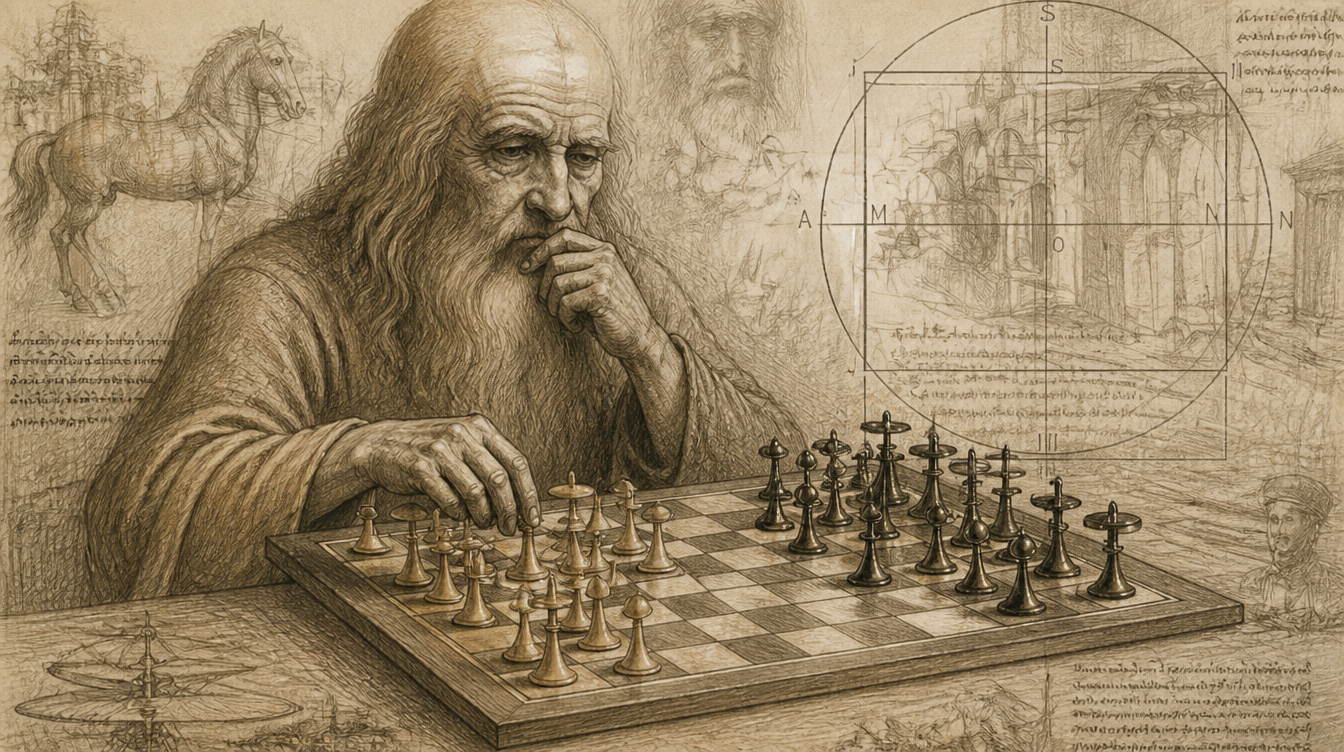
Today, however, I regard Leonardo's role rather differently. He almost certainly played chess with Pacioli and may well have designed the original pieces that adorn the manuscript.
Yet it now appears distinctly improbable that the great Renaissance polymath was responsible for composing the remarkable chess problem itself.
Although no contemporary record survives of Leonardo da Vinci playing a complete game of chess, the cumulative historical evidence strongly suggests that he understood the game intimately, employed its terminology and very likely produced the innovative chess-piece designs for Pacioli's celebrated De ludo scachorum of around 1500.
The evidence is persuasive. Leonardo's Fogle di Windsor (1484–1487) contains a linguistic rebus referring explicitly to the rook or castling. His close collaboration with Luca Pacioli during their years under Isabella d'Este's patronage is well documented. Furthermore, the Italian architect Franco Rocco concluded, following detailed examination of the rediscovered manuscript, that the distinctive chess-piece designs display Leonardo's characteristic left-handed drawing technique and his unmistakable concern for geometric proportion.
For the wider historical background, Richard Eales's Chess: The History of a Game remains indispensable. Those interested in the remarkable piece designs should also consult any specialist online references devoted to Pacioli's manuscript. For a broader appreciation of Leonardo's astonishing cast of mind, Michael Gelb's bestselling How to Think Like Leonardo da Vinci provides an indispensable introduction.
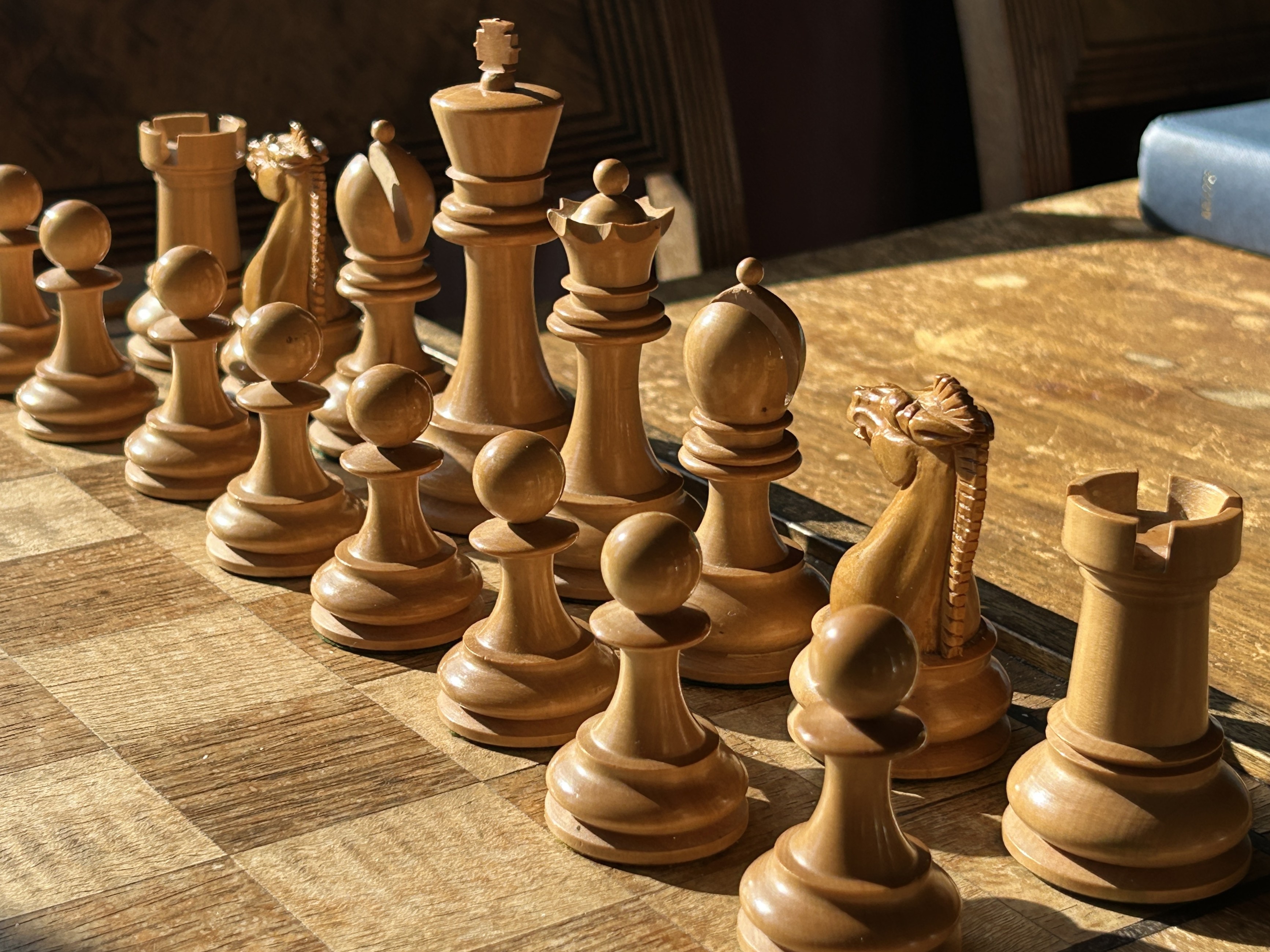
So, Howard Staunton, world chess champion avant la lettre, was certainly the chess colossus of Europe from 1843-1851. Noted as: prolific author and columnist on chess, regulator of the rules, organiser of the first major international chess tournament, eponymous hero of the Staunton pattern chess pieces, now the standard for all competitions, actor, Shakespearean scholar and editor, educational theorist and archivist of the English great schools… and Leonardo, artist, painter, scientist, anatomist, designer of planes, tanks and submarines, what unites these two paragons of mentation, is an astonishingly variegated commitment to thinking, the brain and the elusive pursuit of the spirit of genius.
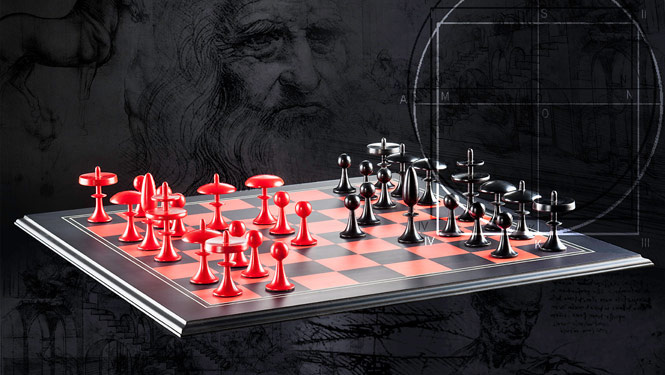
Leonardo Chess Set