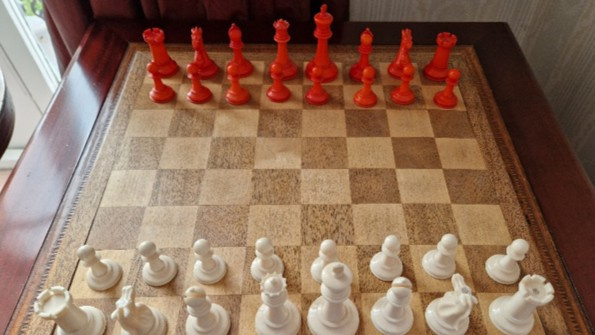
During August 2025, before I joined the Howard Staunton Society, I started an email discussion with our Co-founder, Raymond Keene OBE. He needed help to repair a Jaques In Statu Quo travelling set that he owned (Picture below), so we arranged for me to visit him at his South London Home, which was a double pleasure as this was the area near where I grew up and went to school. Ray Keene owns a number of chess sets but he does not class himself as a ‘collector’.
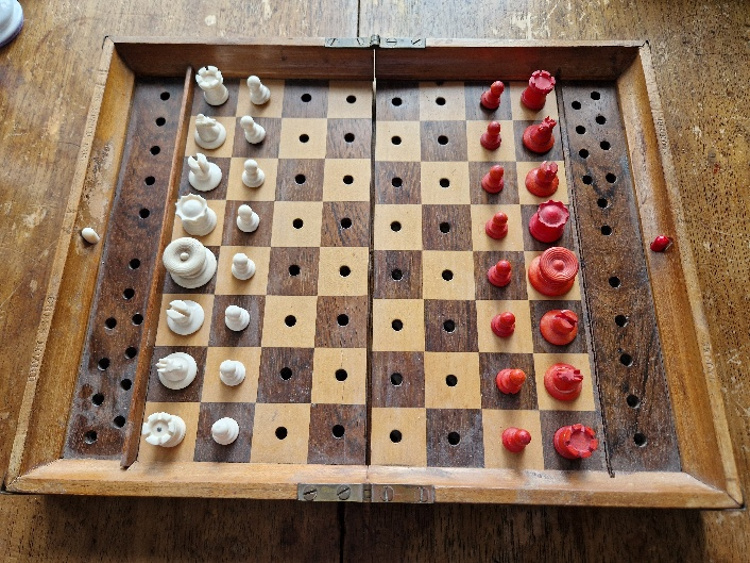
Ray Keene’s Jaques In Statu Quo set, dating to the early 20th C.
Raymond Keene retired from competitive play in 1986, but his active chess playing resume is very impressive. Ray was a British junior chess champion and competed at the highest levels. He won the British championship in 1971 and was the first player from England to earn a Grandmaster norm in 1974. He was awarded the title of Grandmaster itself in 1976. He represented England at many international chess competitions and Olympiads for nearly two decades, which included the famous chess Olympiad in Havana in 1966. The record of his achievements as a chess player is too long to list here - for full details please refer to: https://en.wikipedia.org/wiki/Raymond_Keene.
Ray Keene was also a FIDE International chess arbiter, and after he retired from playing, he became a chess organiser, journalist and author. He brought Victor Korchnoi and Garry Kasparov together for their 1983 Candidates' semi-final match in London and also arranged for the first half of the 1986 World Chess Championship return match between Kasparov and Karpov in London. Again, his involvement in organising chess matches is impressive. He became the chess columnist for a weekly magazine called ‘The Spectator’ in 1977, which lasted for over 40 years. Ray has appeared on BBC television commentating on six World Championships, and he has written over 200 books on chess and mind games.
Ray was awarded the OBE (Order of the British Empire) in 1985 for services to chess. Today, Raymond Keene writes a column for ‘The Article’, which is an online magazine. He founded, and is currently President of, The World Memory, Mind Mapping and Speed Reading Sports Councils, and is also President of the Governing Council at the Institute of Brain Chemistry and Human Nutrition in London. Again, the list of his current activities is extensive.
Chess sets
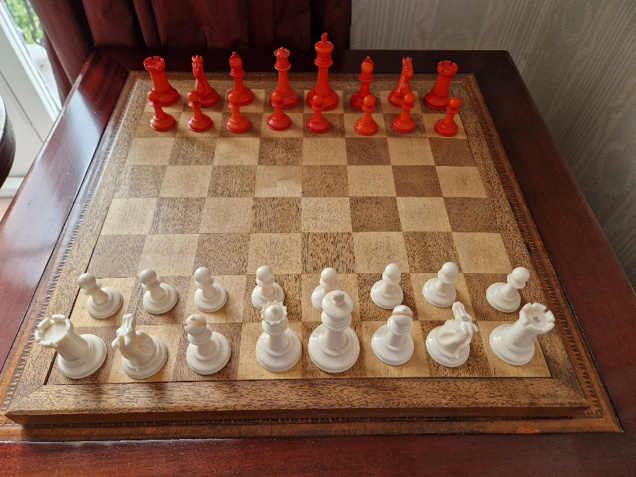
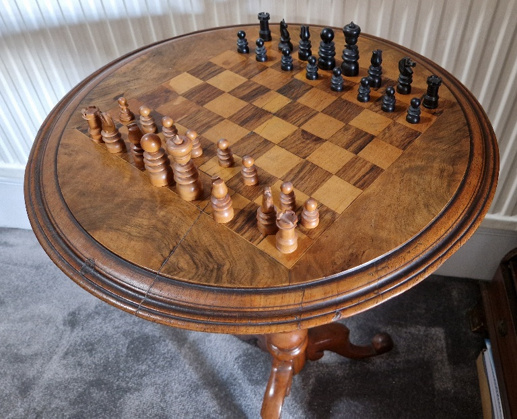
The chess sets owned by Ray Keene vary from antique 19th C Jaques sets, to a late 20th C Polish set. My eyes first rested on an impressive Ivory Jaques set, which has since been dated, via a Facebook group to ~1900 (pictured above). In his hallway stands an antique chess table, made from Walnut, which dates from the early 1800’s and was set up with a contemporary St George style set (see below).
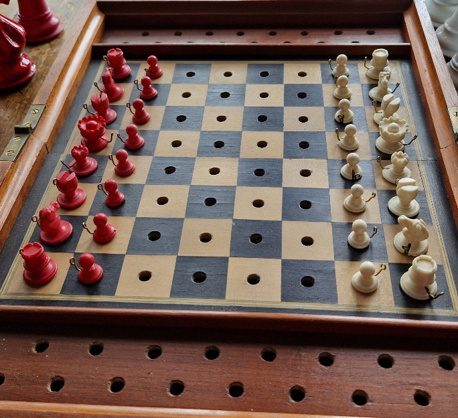
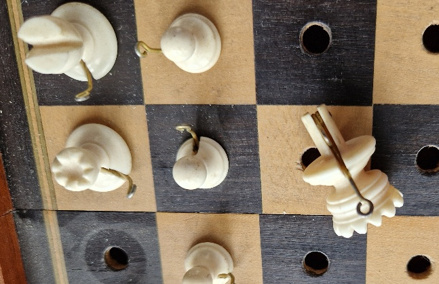
Ray showed me an interesting item that I had never seen before! It was a French travel set which was made in the style of the Jaques In Statu Quo design, but with a unique locking mechanism for the pieces. Each chess pieces has a small ‘spring’ arm, which opens and shuts a split peg underneath the chess piece. You pick up each piece by squeezing the spring arm, which allows it to be removed. When the piece is replaced it automatically releases the spring arm and locks the piece back in the board. (See following Pictures)
Over the years, Ray has sold a number of sets that he owned, which he now regrets letting go off. He used to have a very rare, large size, BCC set in Ivory, which is now in the collection of Jon Crumiler. He also sold his Staunton ‘Havana’ set, which was a reminder of his achievement at the chess Olympiad in 1966.
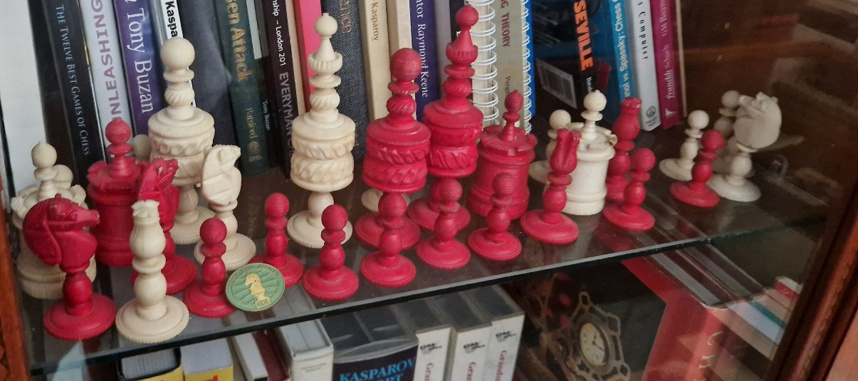
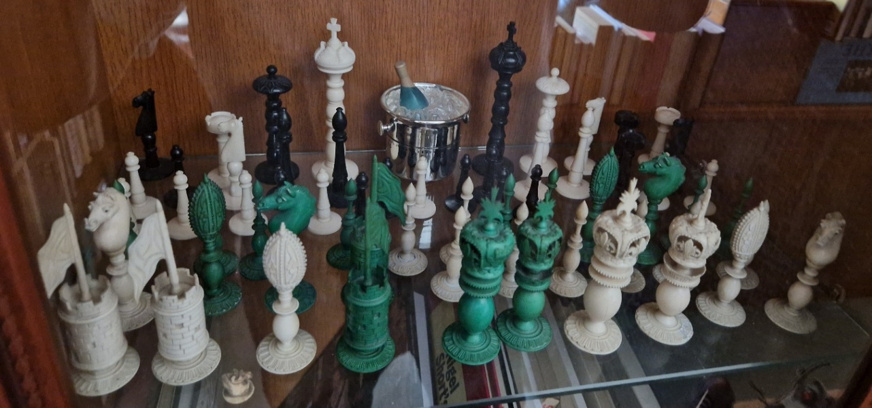
I discovered more chess sets in a glass cabinet in his home office. The pictures below are of three sets, one being a19th C, English Barleycorn set in Bone, then a very nice Green / White ‘Burmese’ set made from Ivory which also dates to the 19th C and behind this a black / white 20th C Indian set probably made from camel bone.
(Note: This article first appeared in The Chess Collector magazine in November 2025)