
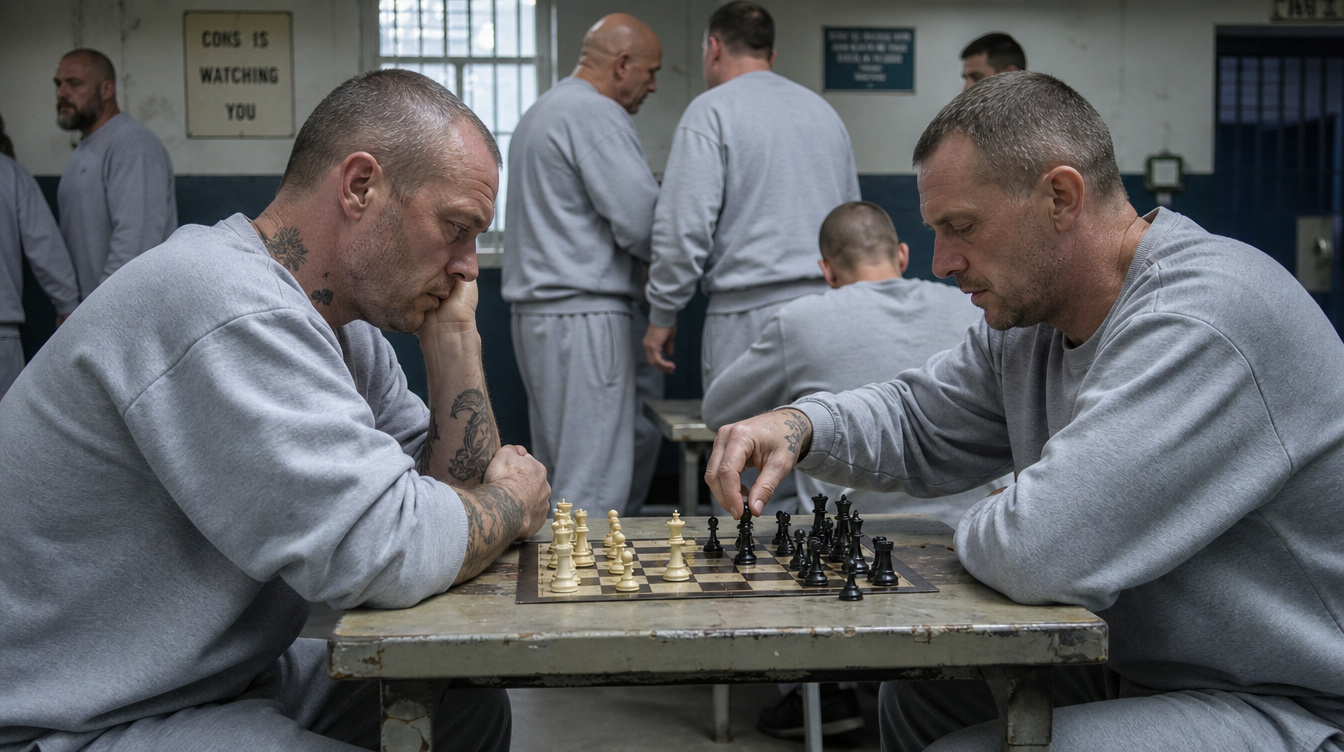
There has been much discussion recently about overcrowding in the UK prison system and who should, or should not, be offered early release back into society. Even Andy Burnham has become directly involved in this debate. I write with some experience in this matter. Far from indulging in ultracrepidarian fantasies, I worked for some time in the Home Office Prisons department, before going up to Trinity College, Cambridge, where I shared lodgings for a year with the future King Charles III. In this article I focus on the praiseworthy efforts of the National Director for Chess in Prisons, Carl Portman. In what follows, I will quote extensively from the Director’s own writings:
“In 2022 I volunteered to manage a team of chess players at HMP Hewell and enter them into the International World online prison chess championships as one of the England teams. My partner in this venture was Nigel Towers, Director of Home Chess at the English Chess Federation. We only had a few weeks to select and coach a team.
We were informed that some of the prisoners interested in playing were difficult to manage, but it has always been the case that in the arena of chess, there are seldom any problems and prisoners of all backgrounds, ethnicity, etc., just come together to play. They keep their personal issues or grievances to the wing.
In brief, this is how we went from (supposed) zeroes to heroes in a few weeks. We certainly had challenges – the main one being that some prisoners were only held for a short time, and although they might be good players, they would be released before the day of the competition.
Therefore, we had to try to select people that would still be in custody at the time of the event and, of course, those who were good enough at chess to compete with some of the international teams, including the Philippines, India, Germany, the USA and more.
What we needed from the prisoners was a commitment. They had to realise that not everyone would be selected, that chess is a meritocracy, but that we would do our best to prepare them for the finals.
They needed to be self-disciplined, committed to the group and to me and Nigel. If they could do that, we were good to go. We were very open with them, saying that anyone who could not do this could leave the group immediately – they were free to go.
None did.
How do you bring a group of prisoners together, some of whom do not know one another, some from different countries, speaking different languages? We had men from England, Albania, Somalia and Romania.
Well, that is where chess comes in. Since it is played worldwide and is a standardised game, it is therefore a universal language which anyone could understand.
Prisoners had textbooks (in English and Romanian!), homework sheets, and face-to-face sessions when Nigel and I visited. They were trusted to go online (supervised) and learn how to use the chess.com platform, where the finals would be played.
To a man, each player met every commitment. They attended every session, they did their homework, they worked together to improve. They worked with staff to make the best of their time, and it was a revelation.
The main team was selected, and the others volunteered to support them. This noble commitment was rewarded when we learned that we were able to change players so that everyone in the squad would get at least one game. Everyone played, and they even drew with Germany, which was wonderful. They all had t-shirts with a specially designed logo, along with books and certificates.
A few weeks later Nigel and I returned to HMP Hewell with the BBC, who made a short video about that and chess in prisons in general.
The players told us that they felt a great sense of self-worth and self-esteem, that they had developed a discipline in preparing for something, individually and working together and of course there was also the great sense of achievement, understanding that with hard work, results would come.
This, in my view, is what prisons should be doing. Yes, you can lock an inmate up for 23 hours a day and deprive them of education and mental stimulation (deliberately or otherwise), but don’t be surprised that, upon release, society has within its numbers bitter, angry and frustrated individuals.
The point of this simple exercise is that chess can give prisoners a hand up in life.
Why chess in prisons?
Let me recap…
1. Chess is for everyone
2. Regardless of age, gender, race, intellectual capacity, ability or background, anyone can play.
3. It is inclusive, and it is a meritocracy. If you are 9 or 90, you can play!
4. Chess is a social game.
5. It helps people to make new friends, and it builds relationships. Often, inmates who would
never spend time together will happily sit and play chess.
6. Chess reaches across the educational spectrum.
7. Chess incorporates aspects of English, mathematics, art, history, religion, geography and
sport.
8. Chess improves memory and concentration.
9. Chess helps people to assess a situation and to use logic for personal growth.
10. Chess demands responsibility for actions. There is no one else to blame. Once we have made our move on the chessboard (as in life) then we can’t take it back. It means that we have to think before we act and that once we act, we alone are responsible and accountable for the consequences, good and bad. We must learn to be magnanimous in both victory and defeat.
11. Chess is an excellent (productive) use of time. Time is a prisoners’ toy. It is something they have in abundance. Maximising the use of that time in a positive way is a good thing to do and chess delivers positively in this area.
12. Chess can be played anywhere. Especially in a prison cell. Chess is inexpensive, and a simple set and board can accompany a prisoner anywhere. It is education in cell time.
13. Chess requires discipline. Chess is, after all, a war game and without planning and preparation the odds of failure are greatly increased. Strategy and tactics are fundamental to improvement. It requires precision and concentration and is a test for us as individuals.”
Carl Portman is right. There are indeed many examples in history of those imprisoned turning to chess as a way of keeping their brains occupied, while they were out of circulation. A notable example of politically motivated incarceration was the former Prime Minister of Israel, Menachem Begin, who helped to keep his formidable mental powers in shape whilst jailed by the British Mandate authorities in Palestine.
There are also cases of strong chess players in their own right finding themselves behind bars. For example, the two US International Masters, Norman Whitaker and Raymond Weinstein, were jailed respectively for confidence trickery and murder.
The Yugoslav Grandmaster Milan Matulovic was sentenced to nine months for careless driving after a fatal car crash, while the two World Champions Wilhelm Steinitz and Bobby Fischer both found themselves under arrest for bizarre reasons. In 1891, Steinitz was arrested in New York and accused of spying after the moves of a correspondence game with the Russian grandmaster Mikhail Tchigorin were intercepted. An employee in the telegraph company reported him to the police, suspecting that the moves were coded military secrets. The fact that the word “Zug” in German means both a “chess move” and a “train” did not help. Steinitz was, however, released within 24 hours.
By contrast, Bobby Fischer was arrested and incarcerated twice. The first time was in Pasadena, California, in May 1981, when he was falsely suspected of being a bank robber. On that occasion, he was released after two days, but later published a pamphlet claiming to have been tortured. The second occasion was in Japan in 2004-5, when Fischer was detained for using a revoked US passport. A warrant had been issued by the American authorities for his arrest for breaching US sanctions against Serbia by playing against Boris Spassky in 1992. He was held in Japan for nine months and was only released on being granted Icelandic citizenship in March 2005.
Other incarcerated chess players — including Alexandre Deschapelles, James Mortimer, Ludek Pachman, Alex Wojtkiewicz, Vladimir Petrov and most illustrious of all, Garry Kasparov — were all jailed for political dissidence or on matters of principle.
Mortimer was, by profession, a dramatist and newspaper editor. He spent three months in prison in 1879. The crime for which he was imprisoned was refusing to reveal the name of an author of an article, which was the subject of a libel suit. While inside, Mortimer taught his fellow inmates how to play chess!